
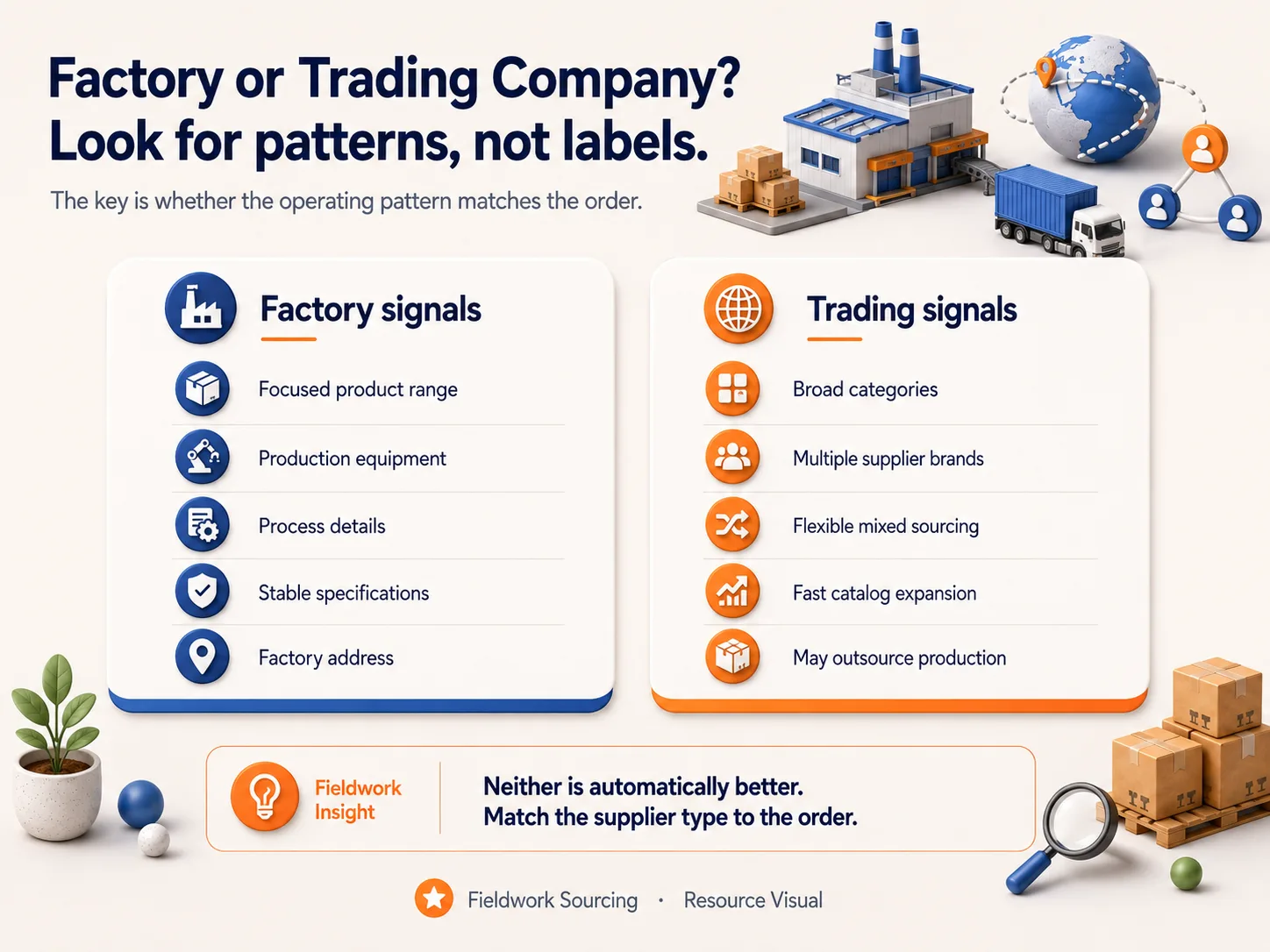
Do not assume “factory” automatically means better
Many buyers start with the idea that a factory is always cheaper and a trading company is always unnecessary. In practice, the better choice depends on the order. A specialized factory may be ideal for a stable, high-volume product. A trading company can be useful when you need multiple products, mixed quantities or more coordination across suppliers.
Look at the product range
A manufacturer normally has a production boundary. Its product catalog often stays within related materials, processes or product families. A company selling completely unrelated categories - for example kitchenware, beauty tools, electronics and furniture hardware - is more likely to be trading across several factories. This is a clue, not proof.
Ask production questions
Instead of asking only “Are you a factory?”, ask about the production process. What equipment is used? Which steps are done in-house? Which steps are outsourced? What is the normal capacity? What causes lead-time changes? A real manufacturer should usually be able to answer process-level questions with consistency.
Check whether the business details match the story
Look at the registered company name, address, product focus, photos, certificates and any available factory information. If the company claims to manufacture one type of product but its business details, location or product catalog tell a different story, investigate further.
Match supplier type to the order
If you need one technical product in volume, direct factory communication may be valuable. If you need ten different products in small quantities, one capable trading company may reduce coordination cost. The goal is not to eliminate trading companies. The goal is to know what role the company is playing in your supply chain.
 WhatsApp
 WeChat
 Google Email