
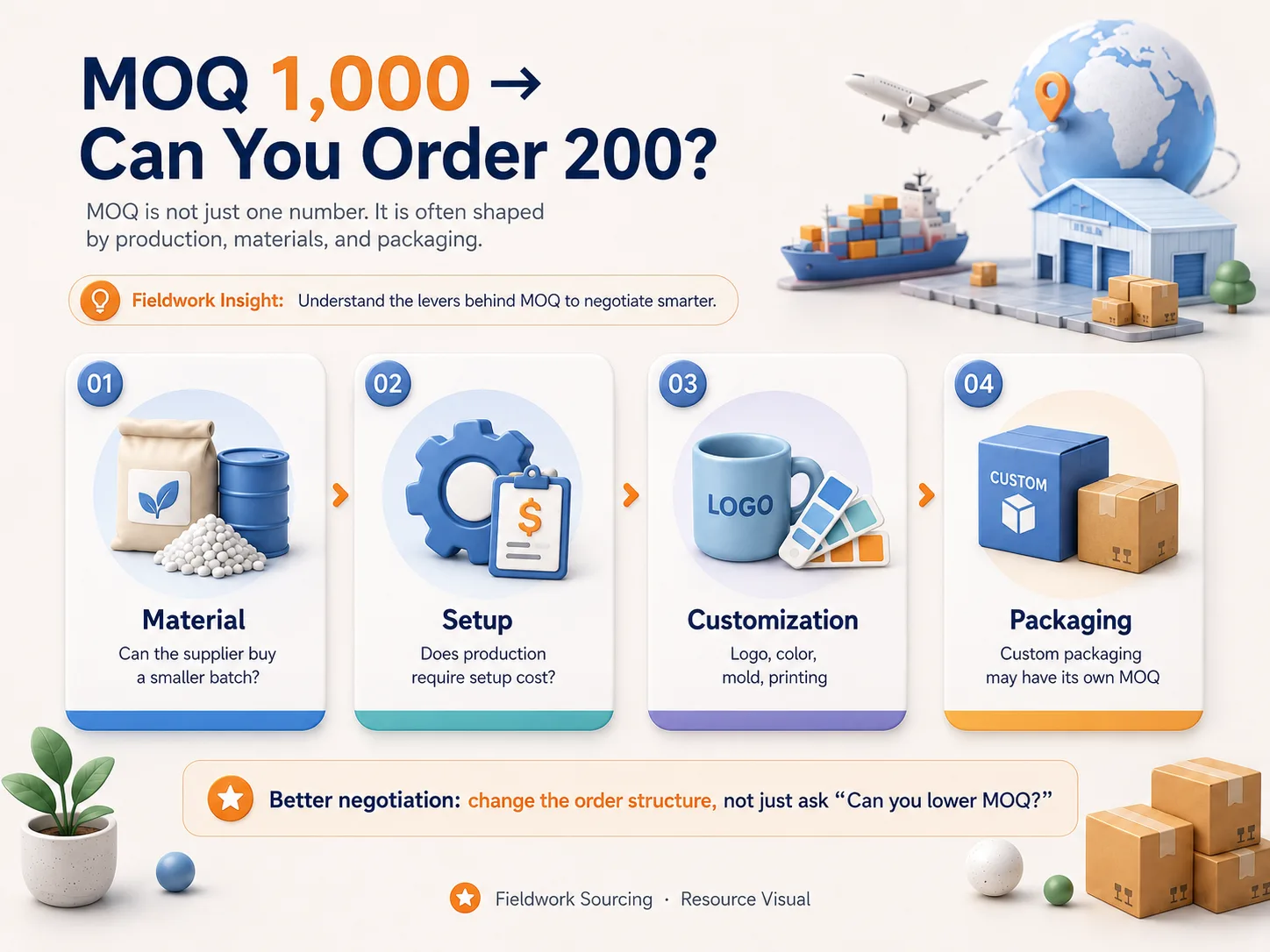
MOQ is usually tied to a real production constraint
A minimum order quantity is not always an arbitrary number. It can come from raw-material purchase quantities, machine setup, printing plates, color mixing, packaging suppliers or the minimum batch that makes a production run economical. If you understand what creates the MOQ, you have a better chance of negotiating it.
Ask what part of the order creates the minimum
Instead of saying “Please reduce MOQ to 200,” ask a more useful question: Is the MOQ caused by the product itself, the custom color, the logo, the packaging or the material? Sometimes the factory can produce 200 standard units but needs 1,000 pieces for custom packaging. Separating those requirements can open a workable solution.
Change the structure of the order
Several approaches can reduce the practical minimum: use a standard color, remove custom packaging, accept a stock material, combine several variants into one production batch, pay a setup charge or start with a paid sample plus a smaller trial order. Not every factory will agree, but these options give the supplier something concrete to evaluate.
Expect the unit price to change
A smaller quantity often means a higher unit price because setup and material costs are spread across fewer pieces. That does not automatically make the order unattractive. For a new product, paying more per unit for 200 pieces may be safer than buying 1,000 pieces before demand is proven.
Use the trial order to prove the next order
For a small buyer, the first order can be treated as a test. If the specifications are clear, payment is reliable and the next order is realistic, some suppliers become more flexible after the first successful cooperation. A long-term purchasing pattern is often more persuasive than a promise to become a “big customer someday.”
 WhatsApp
 WeChat
 Google Email